Raimund Speidel
The LighthouseRaimund Speidel, a German diplomat and former ambassador to Beijing, arrives on Combe Island as a first-time visitor and becomes both a key witness in Nathan Oliver’s death and the source of a public-health crisis. His scheduled meeting with Oliver places him near the lighthouse at the critical hour, while gaps in his account leave the investigators uncertain about what happened there. Soon afterward, Speidel is diagnosed with SARS and transferred to Plymouth, bringing the investigation into contact with illness, isolation, and the limits of police access.
Identity and Arrival
Speidel is one of the visitors whom Rupert Maycroft cannot compel to remain on the island while the murder inquiry proceeds. He has arrived only on Wednesday, and Maycroft initially doubts that a first-time visitor will have useful information. Yet Speidel has made an appointment to meet Oliver, and that connection gives his brief stay immediate significance.
When Maycroft summons him, Speidel has just returned from a walk. He looks ill: his face is flushed and sweaty, and beads of perspiration stand out on his brow. On a mild autumn afternoon he is wearing heavy trousers, a thick wool roll-neck, a leather jacket, and a scarf. He explains that he began to feel unwell on the boat but did not consider himself sick enough to cancel. He hopes rest and fresh air will help, and says he would regret bringing influenza to the island. His attempt to minimize the illness contrasts with the severity that soon becomes apparent.
Speidel tells Dalgliesh that he did not know Oliver personally and does not presume to understand him as a man; he can speak only to the writer. He does, however, offer information about the time of death. His distinction between the public author and the private person also establishes a limit to what he claims to know: knowledge of Oliver’s work is not, in his account, intimacy with Oliver himself.
The Lighthouse Appointment
Speidel says he arranged to meet Oliver in the lighthouse at eight o’clock on the morning Oliver died. After a restless night with fever, he set out late and reached the lighthouse at six minutes past eight. The door was locked, so he says he could not enter or meet Oliver. His account supplies investigators with a possible time marker, but also makes his own presence at the scene impossible to disregard.
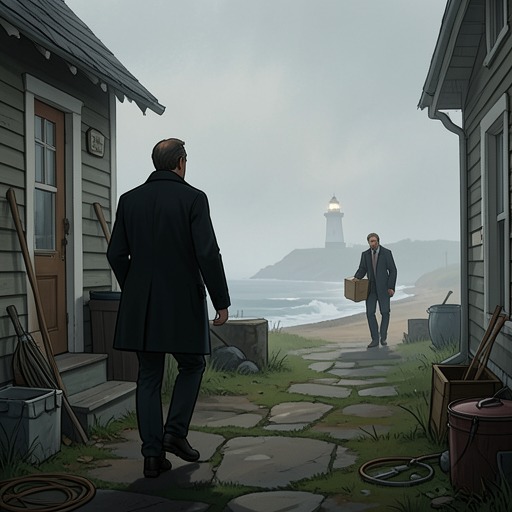
He says he walked rather than ordering the buggy. After passing Atlantic Cottage, he climbed down to the under-cliff path, following it until it became impassable about twenty metres from the lighthouse. He explains that he hoped not to be observed. The secluded route makes his movements difficult to verify and gives his visit a deliberately private quality. He later returns to the lighthouse; according to the account discussed by the investigators, the door is then open and the climbing rope is missing. He says he heard nothing, although the distance from the upper killing chamber could explain why.
The appointment’s timing raises further questions. Millie Tranter says she delivered Speidel’s note by putting it in the letterbox at Peregrine Cottage, and admits that she told Jago Tamlyn about the meeting. Miranda Oliver, Dennis Tremlett, or someone with access to the buggy might also have read it. Investigators therefore cannot establish from the note alone whether Oliver received it or why he set out for the lighthouse at about seven-twenty, earlier than the stated appointment. The possibility that the time was altered is considered, but a change of only thirty minutes would leave a narrow window for an attacker to meet Oliver, kill him, and escape.
Speidel’s account initially makes him a possible suspect: if the door was locked when he arrived, someone was inside, and the available evidence does not independently prove either that the door was locked or that Speidel never met Oliver. His claim that he had a personal interest in lighthouses also proves false. Those contradictions make his evidence less complete than it first appears, without by themselves establishing that he killed Oliver. His stated role remains that of a witness whose account both helps fix a time and requires scrutiny.
The Island’s Wartime Past
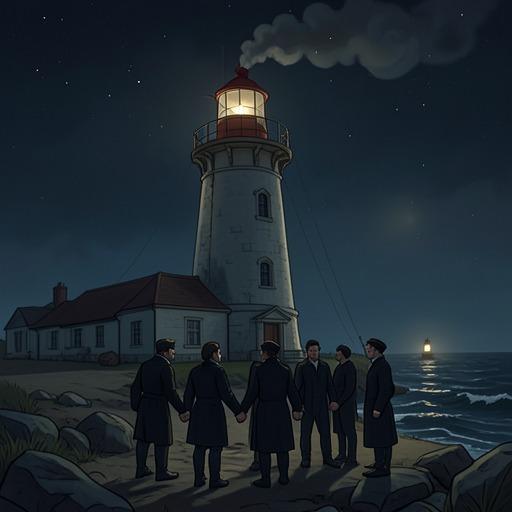
Speidel is also connected to the unresolved story of three German officers who came to Combe Island during the Second World War. The officers landed from the occupied Channel Islands on the night of 10 October 1940. Speidel thinks they may have intended to raise a German flag atop the disused lighthouse, perhaps as a risky reconnaissance or private enterprise. The idea links his visit to the island’s wartime history and to the fate of his father and two other officers, whose disappearance forms part of that history.
A later account of the 1940 events describes Saul Oliver setting fire to dry straw stored on the lighthouse’s ground floor while the Germans were inside the tower. The flames and smoke rose through the building; the men could not escape to the lantern, and the lighthouse door had been nailed shut. All three died, probably by suffocation. Saul then carried their bodies back to their boat and scuttled it in deep water. The account comes through a story told years later by Saul, whose purpose in telling it was uncertain. It therefore supplies a possible history of the officers’ deaths, rather than a simple, independently verified explanation. Speidel’s theory about the men’s intentions places him near this history, but does not resolve its uncertainties.
SARS and Quarantine
Speidel’s illness changes the practical conditions of the investigation. After he collapses, Guy Staveley recognizes SARS as a possibility and arranges his transfer to Plymouth. The diagnosis is confirmed there. Speidel remains seriously ill in a special isolation unit; his wife and some family members arrive from Germany but can see him only under controlled conditions.
The exposure also affects the island. Dalgliesh helped Speidel after his collapse and accompanied him back to his cottage, while Jo Staveley nursed him. Staveley warns that these two are among those most at risk. He explains that SARS spreads primarily through close person-to-person contact, including respiratory droplets or contact with contaminated surfaces, and recommends that everyone on Combe Island accept voluntary quarantine for about ten days. The police inquiry must consequently continue under restrictions, with the possibility that Dalgliesh himself may need transfer if his condition worsens.
Dalgliesh does contract SARS and becomes gravely ill on the island. His illness temporarily removes him from active investigation, but his final disjointed memories of Tuesday include the insistence that he must remain on Combe Island because the lighthouse case is unfinished. Speidel’s role thus extends beyond supplying a disputed account: his infection sets off the quarantine that isolates the investigators and contributes to the medical crisis within which the case must be completed.